
Travel money guide
AED for Dubai, Hajj or Umrah: cash limits and documents
How private UAE travel and Haj/Umrah differ under RBI cash rules, which documents to bring in Ahmedabad, and how Mahaforex facilitates through authorised dealers.
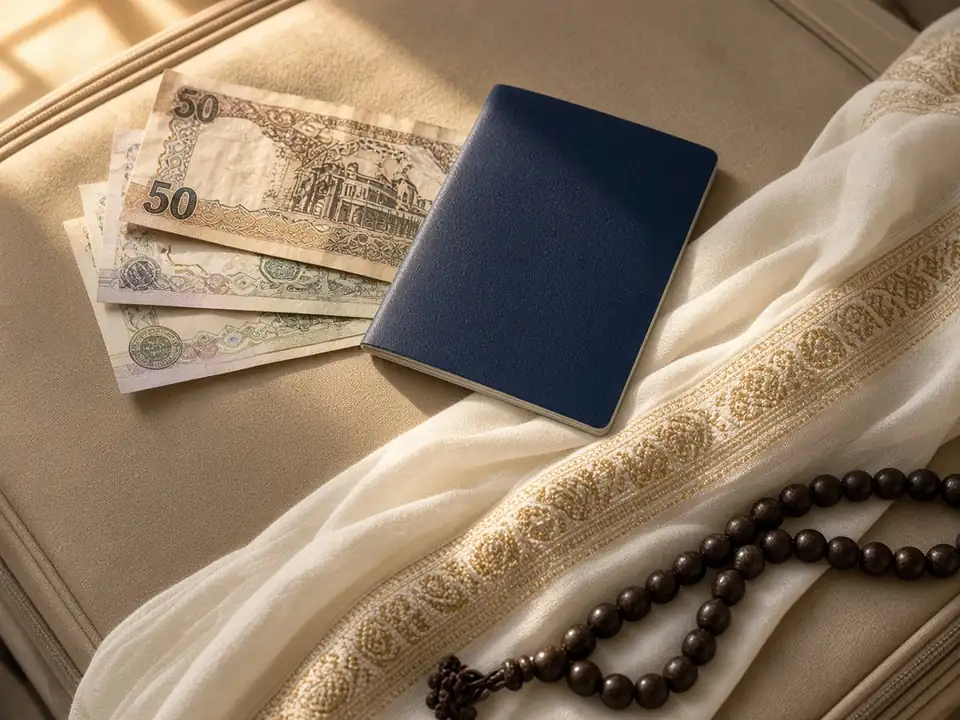
Families in Ahmedabad often ask about UAE dirhams for a short Dubai or Abu Dhabi trip, and, in season, about cash for Haj or Umrah. The two situations share a currency and a need for tidy documents, but they do not always share the same cash rules. This article separates them, cites the Reserve Bank of India where limits are stated, and explains how Mahaforex can help as a facilitator.
We are not an RBI-authorised dealer or FFMC. Dirhams and any cash released for pilgrimage are issued by authorised dealers or FFMCs. You pay that dealer directly. The dealer issues the invoice. We collect the currency and hand it to you with that invoice.
Private travel to the UAE
For an ordinary holiday or family visit, the general travel-cash rule applies: for most destinations, foreign currency notes and coins may be obtained up to USD 3,000 per visit or its equivalent, with the rest of your requirement, within the annual LRS ceiling of USD 250,000, carried on a forex card or similar instrument. See the Master Direction – Other Remittance Facilities, paragraph 3.1.1, updated 1 October 2026 and RBI FAQ Q3, updated 28 November 2025.
Bring the standard file: passport, visa if issued, return air ticket, PAN and Aadhaar. If you are travelling as a group, each traveller may need their own set. Call us early if a visa is still being processed.

Haj and Umrah
The same Master Direction and FAQ provide a specific statement for pilgrims: for travellers proceeding for Haj or Umrah, the full amount of entitlement may be released in cash, or up to the cash limit specified by the Haj Committee of India, and this is released by authorised dealers and FFMCs.
That is a rule for authorised dealers and FFMCs, not a licence for any shop to hand out unlimited notes. If you are travelling for Haj or Umrah, tell us so at the start. We will help you assemble the documents the dealer requires, which may include pilgrimage paperwork in addition to the usual KYC and travel proofs. We will not claim a higher limit than the dealer and the Haj Committee allow, and we will not take the currency payment ourselves.
Pilgrimage travel is time-sensitive. Do not leave currency, tickets or visas to the last week if you can avoid it. If you need help with travel arrangements, use bookmytravel.co.in as well as this desk.
Paying for the exchange
Once the authorised dealer accepts the file, you pay that dealer. For sales of foreign exchange for travel of ₹50,000 or more, the Reserve Bank’s FAQ says the entire rupee payment to the authorised person should be by crossed cheque, banker’s cheque, pay order, demand draft or card, not cash (FAQ Q6, 28 November 2025).
After you return
Unspent notes and traveller’s cheques should generally be surrendered to an authorised person within 180 days, subject to the permission to retain up to USD 2,000 in notes or traveller’s cheques, and to hold coins without that cap (FAQ Q7–Q8). If you want help selling leftover dirhams through a partner dealer, ask us — we can introduce the request; we cannot complete it in our own name.
A practical timeline
If your departure is a month away, you have time to check visas, tickets and the dealer’s document list in an unhurried way. If you have ten days or less, call us the same day and say so. We will tell you honestly whether a same-day or next-day handover is realistic once the authorised dealer has seen the papers. Pilgrimage groups should appoint one family member to coordinate documents so names, passport numbers and travel dates are consistent across every file.
To begin, WhatsApp or call +91 81285 20940, or use the enquiry form and mention whether the trip is a private UAE visit or Haj/Umrah.
This article is general information. Mahaforex is not RBI-licensed; currency and outward remittance are arranged through partner authorised dealers. You pay the authorised dealer directly. Limits cited from Reserve Bank publications can change — check rbi.org.in.